Aug 7, 2026
Why My Most Contrarian Substack Post Outperformed My Growth Reports
My most opinionated post got the most views, opens and discussion—but the practical post was the only one that directly generated a subscriber.
I started this publication from zero less than a week ago.
Since then, I’ve tested several types of content:
growth reports
practical acquisition lessons
opinionated takes
warnings about common growth tactics
One pattern stood out quickly.
My article warning about subscribe-for-subscribe attracted more views, a higher open rate and more discussion than my straightforward growth reports.
That does not prove contrarian content always wins.
But it is enough to make me test the idea further.
The baseline
Starting point: 0 subscribers
Current publication: 100 subscribers
Time period: less than 7 days
7-day views: 328
Main objective: understand which types of content attract attention, discussion and eventually active readers.
The subscriber growth is useful context, but this experiment is really about content performance, not about claiming that one article caused the growth.
The numbers
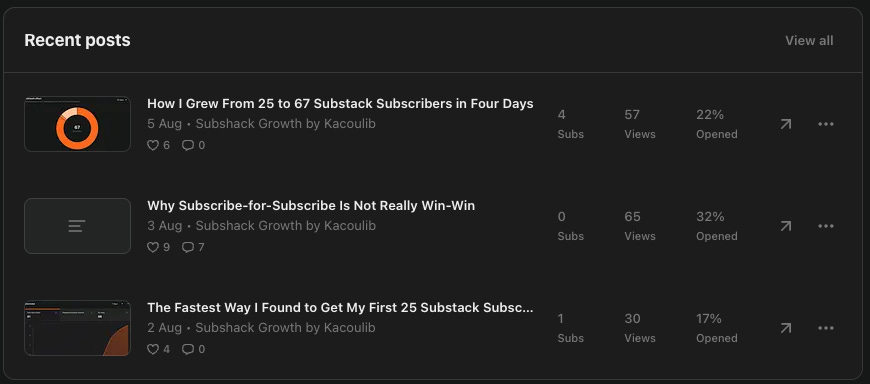
Here are the three articles I compared.
Why Subscribe-for-Subscribe Is Not Really Win-Win
62 views
30% open rate
8 likes
7 comments
0 directly attributed new subscribers
How I Grew From 25 to 67 Substack Subscribers in Four Days
43 views
19% open rate
0 directly attributed new subscribers
The Fastest Way I Found to Get My First 25 Substack Subscribers
29 views
17% open rate
1 directly attributed new subscriber
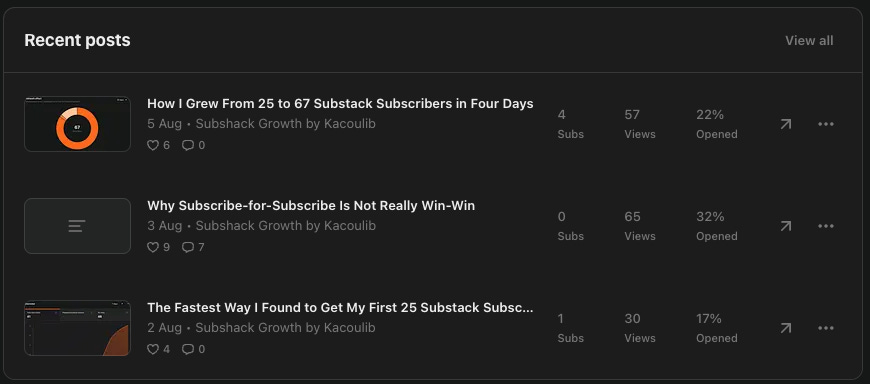
The warning about subscribe-for-subscribe had:
the most views
the highest open rate
the most visible discussion
But the practical “first 25 subscribers” article is still the only one showing a directly attributed subscriber.
That distinction matters.
The article that got the most attention
The strongest-performing article was not a growth update.
It was a warning.
Why Subscribe-for-Subscribe Is Not Really Win-Win challenged a behavior many new Substack creators are actively using.
That gave the article something my growth reports had less of:
tension.
The reader immediately has something to react to.
They may agree.
They may disagree.
They may be doing subscribe-for-subscribe themselves.
They may have already been burned by it.
Either way, the topic gives them a reason to care before they even open the article.
Why the warning may have worked
I think three things helped.
1. It addressed a recognizable behavior
Subscribe-for-subscribe is easy to understand.
The reader does not need extra context.
They immediately know what the article is about.
2. It contained a conflict
“Grow faster with reciprocal support” sounds positive.
“Subscribe-for-subscribe is not really win-win” introduces a problem.
Problems create curiosity.
3. It invited disagreement
A growth report mostly tells the reader what happened.
A contrarian article gives the reader something to evaluate.
That naturally creates more room for replies and discussion.
But attention is not conversion
This is the part I do not want to ignore.
The contrarian article generated the most attention.
But it generated zero directly attributed subscribers.
Meanwhile, the article about getting my first 25 subscribers had fewer views and a lower open rate, but it generated one directly attributed subscriber.
So there may already be two different jobs happening:
Opinionated content gets attention.
Practical content may convert better.
I do not have enough data yet to claim that as a rule.
But it is a much more useful hypothesis than simply chasing views.
What these numbers do not prove
The data does not prove that more views lead to more subscribers.
It does not prove that a higher open rate creates better retention.
It does not prove that comments turn into long-term readers.
And it definitely does not prove that controversy for the sake of controversy is a good strategy.
The goal is not to become provocative.
The goal is to find real tensions your audience already cares about.
That is a very different thing.
What I’m testing next
For the next 30 days, I’m going to publish more articles built around real Substack tensions.
Not fake hot takes.
Actual questions creators are already dealing with.
For example:
subscriber count vs active readership
growth speed vs audience quality
subscribe-for-subscribe vs genuine discovery
followers vs newsletter subscribers
views vs conversion
I’ll compare:
views
open rate
replies
comments
new subscribers
returning readers
The goal is to understand which topics create attention and which ones actually create audience growth.
Conclusion
My early data suggests that tension earns attention, while practical utility may drive conversion.
Three articles are nowhere near enough to call that a rule. But it’s a strong enough signal to test for the next 30 days.
Related reading
The article that triggered this observation:
Why Subscribe-for-Subscribe Is Not Really Win-Win
I’m documenting what actually works as I grow this Substack from zero.
One tool came out of these experiments, and it is free: a Substack profile audit that scores what a first-time visitor sees on your profile, out of 100.
Subscribe to follow the next 30-day experiment and see which topics create views, discussion and real readers.
Get the next experiment in your inbox: the blog is also a Substack newsletter you can subscribe to.
Subscribe free