Aug 12, 2026
I Stopped Subscribe-for-Subscribe. Here’s the Growth System I’m Testing Instead
For seven days, I’m replacing reciprocal subscriptions with original Notes, meaningful replies, useful articles, a custom domain, and SEO. This is day two.
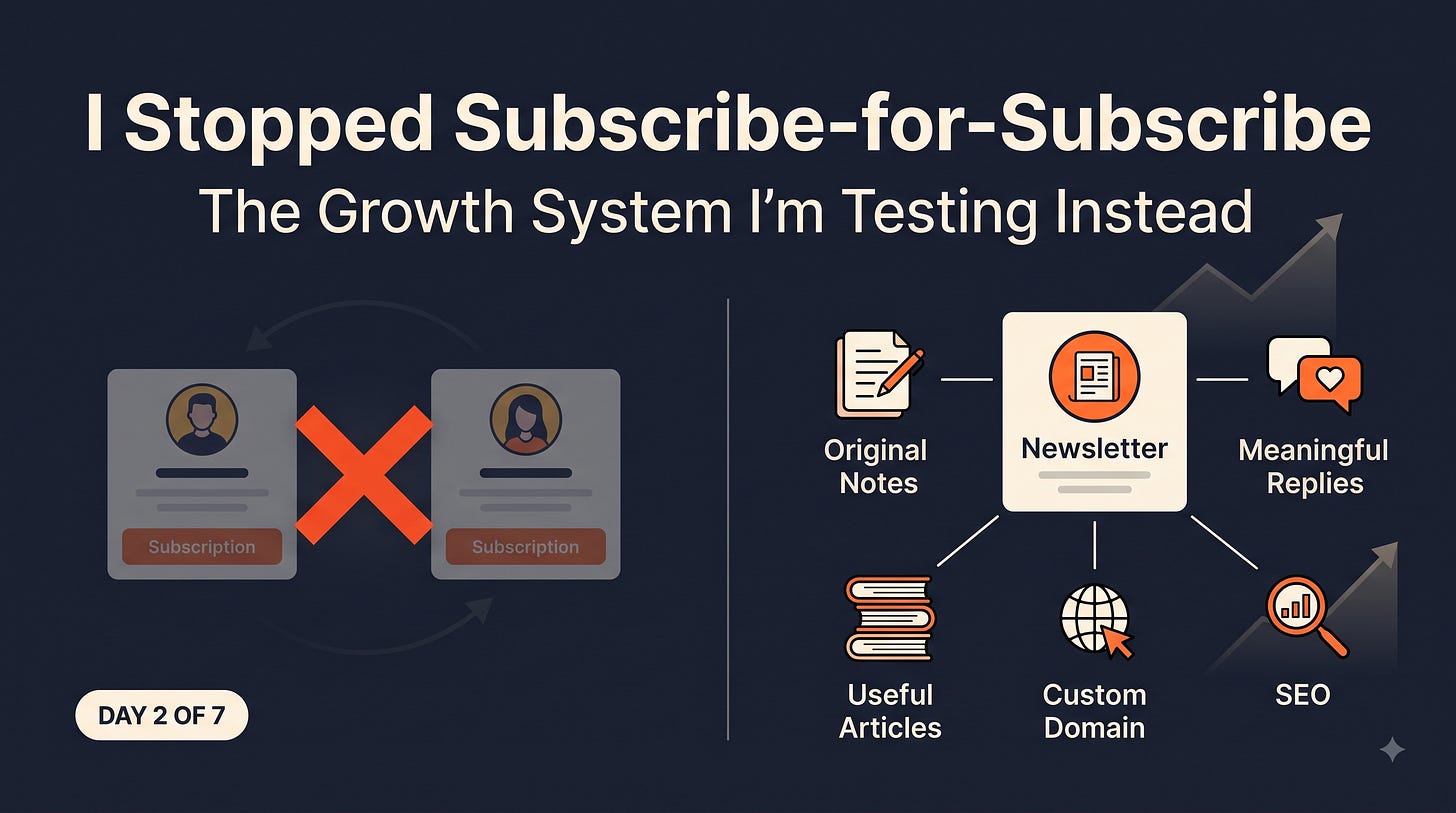
Subscribe-for-subscribe was the biggest acquisition driver during my first week on Substack.
It helped me move from zero to more than 150 subscribers quickly.
That result was real.
But it left one important question unanswered:
Can I continue growing without reciprocal subscriptions?
Getting someone to subscribe because you subscribed to them is not the same as attracting someone who genuinely wants to read your work.
So this week, I’m stopping subscribe-for-subscribe completely.
No “subscribe and I’ll subscribe back.”
No reciprocal-growth threads.
No promising a follow in exchange for a follow.
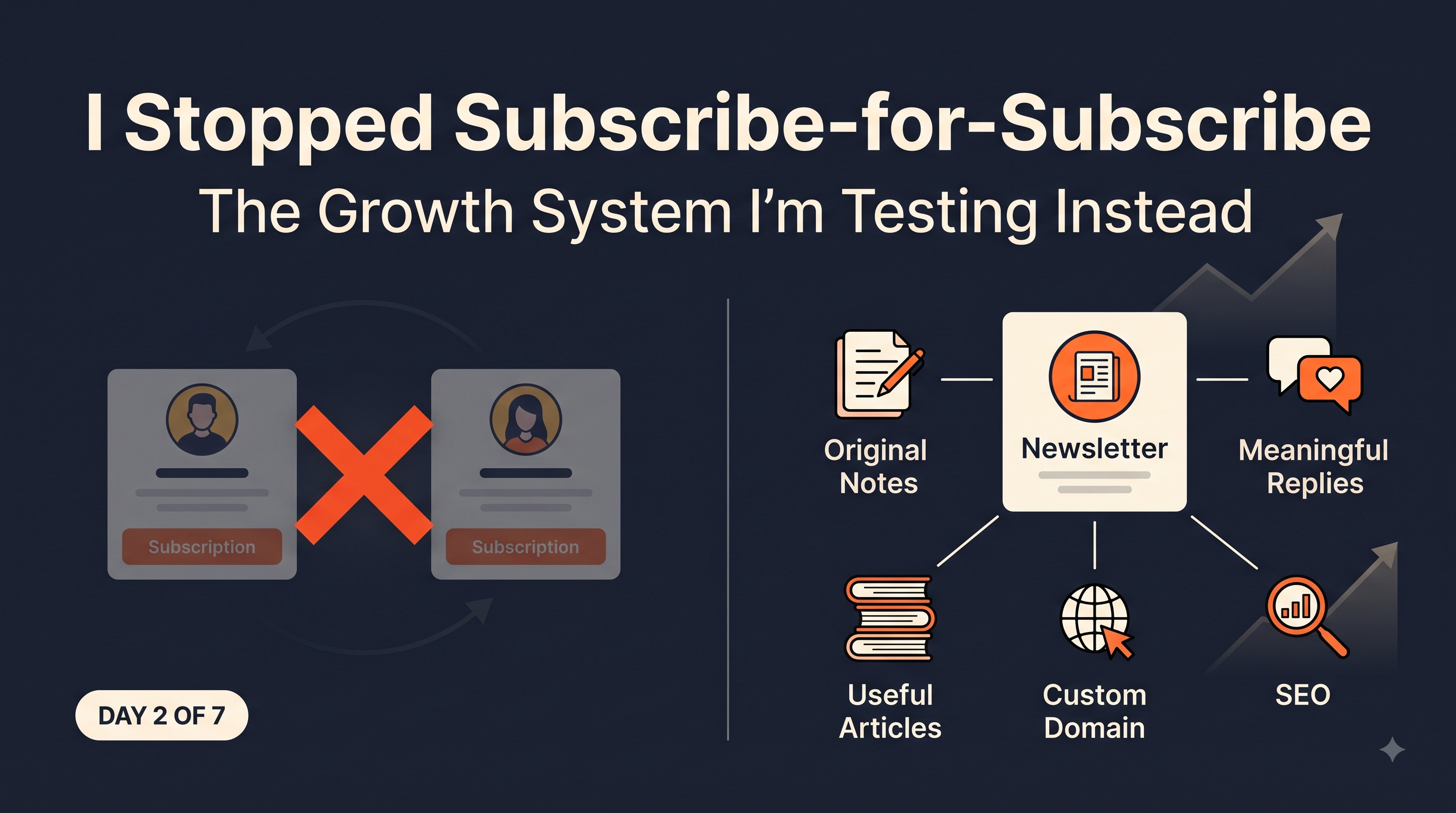
For seven days, I’ll rely on original Notes, meaningful replies, useful articles, a custom domain, and improved SEO settings.
This is day two of the experiment.
Why I stopped subscribe-for-subscribe
Subscribe-for-subscribe solved one immediate problem:
It helped me escape zero.
When a publication is new, almost nobody knows it exists.
Reciprocal-support threads put my profile in front of other creators who were also trying to grow.
That created momentum quickly.
But acquisition speed is not the only thing that matters.
A subscriber gained through reciprocity may have subscribed because of the exchange—not because they were interested in the publication.
That does not make the subscriber worthless.
It simply means the original motivation may be different.
The real test comes afterward:
Will they open the next article?
Will they read again?
Will they reply?
Will they stay subscribed?
Will they care about the topic when reciprocity is no longer involved?
This experiment is not designed to prove that subscribe-for-subscribe is bad.
It is designed to find out whether I can build a second growth engine that does not depend on it.
What I’m testing instead
For the next seven days, I’m focusing on five things.
1. Original Notes
During my first week, I published more than 40 Notes.
Some promoted articles.
Some shared observations.
Some asked questions.
Some documented what I was learning about Substack growth.
This week, the Notes will have one additional constraint:
They must be useful even if nobody subscribes afterward.
I’ll publish Notes around:
practical growth observations
experiments
mistakes
content performance
questions creators are already discussing
lessons from building a publication from zero
The goal is not simply to publish more.
The goal is to find out which ideas create genuine interest.
2. Meaningful replies
I’ll continue replying to other creators.
But I will not promise a subscription or follow in return.
Each reply should add something useful to the conversation.
That could be:
a concrete observation
a relevant question
a nuance
a lesson from my own experiment
a related article when the connection is genuinely useful
The reply should still make sense if the promotional link is removed.
This matters because replies can create discovery without turning every interaction into a transaction.
3. Original articles
During my first week, I published several articles about what I was testing.
The articles were not my largest direct acquisition source.
But they served another purpose.
They gave profile visitors context.
Context only helps if the profile itself is clear. I built a free Substack profile audit that scores what a visitor actually sees, out of 100.
A Note may make someone curious.
An article can help them understand:
what I write about
how deeply I explore a topic
whether the publication is relevant to them
whether they want to keep reading
This week, I’ll continue turning short observations into deeper articles.
Notes create entry points.
Articles create depth.
4. A custom domain
I also connected a custom domain to the publication.
This will not magically create traffic.
And I do not expect a meaningful SEO result after only seven days.
The reason is longer-term ownership.
I want the publication to become associated with a domain that I control, not only a platform profile.
That should make it easier to build:
a recognizable brand
direct traffic
search visibility
links that remain connected to my own domain
a future home for the tools I’m building
The short-term experiment is about Substack growth.
The custom domain is a longer-term asset.
5. SEO improvements
I reviewed the publication and post settings to improve basic SEO.
That includes:
clearer titles
stronger descriptions
relevant topics
internal links between related articles
useful image previews
a more consistent publication position
Again, seven days is too short to properly evaluate search performance.
Google may take longer to discover, crawl, and rank the content.
So I will treat any search traffic this week as an early signal—not proof that the SEO work succeeded.
What I will measure
Subscriber count is still useful, but it will not be the only metric.
I’ll track:
new subscribers
article views
open rates
replies
comments
restacks
direct traffic
traffic from Substack Notes
search traffic
unsubscribes
returning readers
I also want to compare the quality of the signals.
For example:
A Note that generates ten replies may reveal more genuine interest than one that brings five silent subscribers.
An article with fewer views may still be valuable if readers return afterward.
A slower week may still be better if the audience is more engaged.
What would count as success?
Success does not require matching the speed of subscribe-for-subscribe.
My first week was optimized for rapid acquisition.
This week is testing a different system.
The experiment will be useful if I can answer three questions:
Can I continue acquiring subscribers without reciprocity?
Do the new subscribers engage more with the content?
Which Notes, replies, and articles create the strongest signals of genuine interest?
Growth may slow down.
That would not automatically mean the experiment failed.
A smaller number of genuinely interested readers may be more valuable than a larger number of inactive subscribers.
The limitation of this experiment
This is not a perfectly controlled test.
I am changing several things at once:
stopping subscribe-for-subscribe
changing my Notes strategy
publishing new articles
improving internal linking
using a custom domain
updating SEO settings
That means I will not be able to attribute every result to one specific change.
If subscriber growth continues, I cannot say that SEO caused it.
If growth slows down, I cannot say that stopping subscribe-for-subscribe was the only reason.
The goal is simpler:
Can this new system sustain growth without reciprocal subscriptions?
If it works, I can isolate individual parts in future experiments.
My hypothesis
My current hypothesis is:
Growth will be slower, but the people acquired may show stronger signs of genuine interest.
I may get fewer subscribers.
But I may see:
better conversations
more article engagement
more returning readers
fewer transactional subscriptions
a clearer understanding of which content attracts the right people
That is what I want to test.
Why this experiment matters
My first week answered one question:
Can subscribe-for-subscribe create fast initial momentum?
For me, the answer was yes.
This week is designed to answer a harder question:
Can original content, useful interactions, and long-term discovery channels keep the publication growing without reciprocity?
I’m currently on day two.
At the end of day seven, I’ll publish:
subscriber growth
traffic sources
article performance
engagement
unsubscribes
what appeared to work
what failed
what I still cannot prove
The results may be weaker than the first week.
That is part of the experiment.
Subscribe to receive the full seven-day results—whether the numbers are good or bad.
Get the next experiment in your inbox: the blog is also a Substack newsletter you can subscribe to.
Subscribe free