Aug 13, 2026
How I Got 34 Replies on My First Substack Chat Thread
The exact setup I used—and why community may be the missing piece in growing without subscribe-for-subscribe.
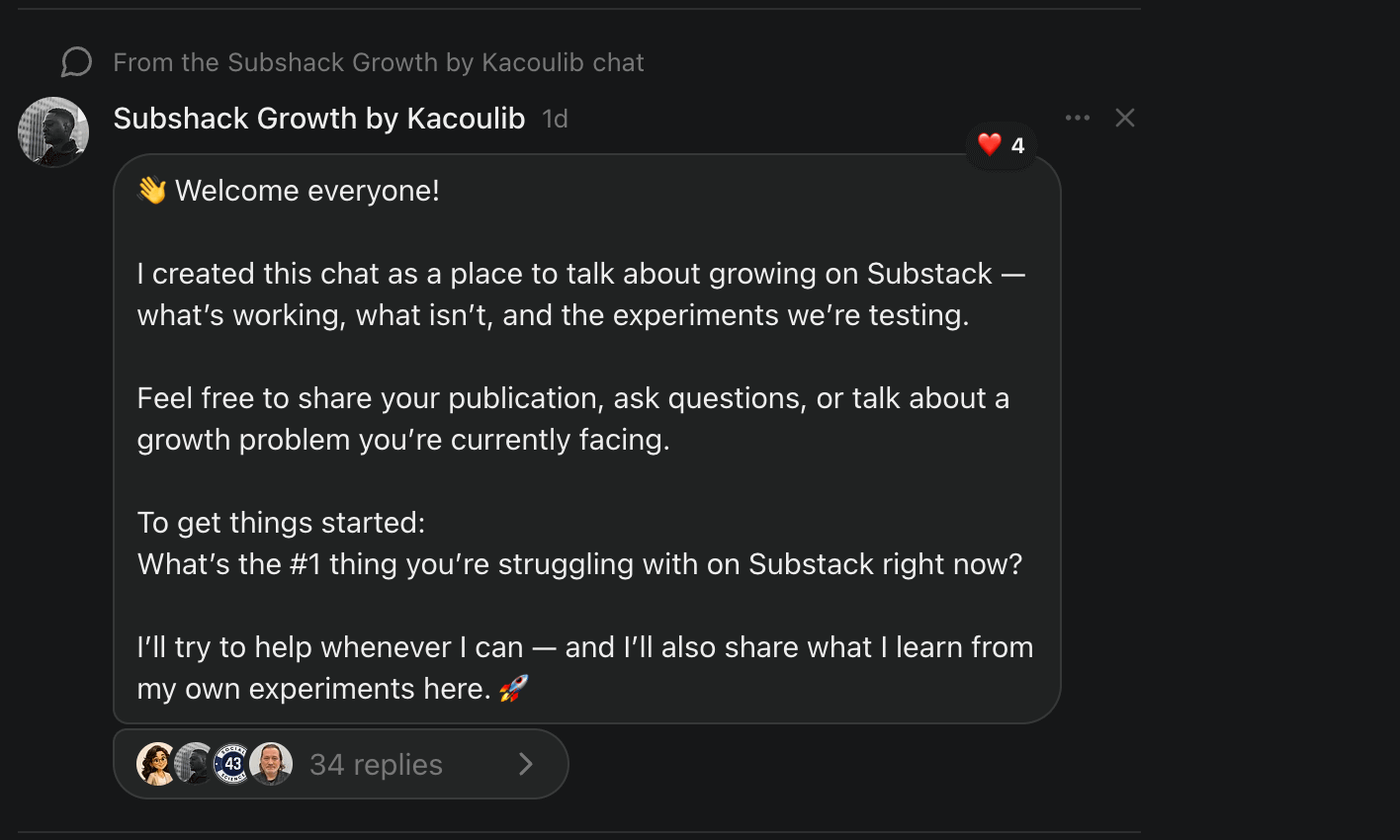
I created my first Substack Chat and asked one simple question.
The thread generated 34 replies.
Here’s exactly how I started it—and the unexpected way Substack promoted it in the Notes feed.
Why I created a Chat
During my first week on Substack, subscribe-for-subscribe was my main acquisition strategy.
It helped me grow from zero to more than 150 subscribers quickly.
This week, I stopped completely.
No reciprocal subscriptions.
No “subscribe and I’ll subscribe back.”
I wanted to discover whether I could continue growing by publishing useful content, writing meaningful replies, and building relationships.
My early observation is that organic growth becomes much harder when your publication doesn’t have a community around it.
Publishing brings people to your work.
Community gives them a reason to return.
The exact message I published
I created a Chat called Subshack Growth by Kacoulib and used this welcome message:
👋 Welcome everyone!
I created this chat as a place to talk about growing on Substack—what’s working, what isn’t, and the experiments we’re testing.
Feel free to share your publication, ask questions, or talk about a growth problem you’re currently facing.
To get things started:
What’s the #1 thing you’re struggling with on Substack right now?
I’ll try to help whenever I can—and I’ll also share what I learn from my own experiments here. 🚀
The thread received four likes and 34 replies.
The likes weren’t the most interesting result.
The replies were.
Why this question generated conversations
I think the message worked for four reasons.
1. The purpose was immediately clear
The Chat wasn’t presented as a general networking group.
It had one specific purpose: helping people discuss and experiment with Substack growth.
People could quickly decide whether the conversation was relevant to them.
2. People knew what they were allowed to share
I explicitly invited members to:
Share their publication
Ask questions
Describe a growth problem
Discuss their own experiments
They didn’t have to guess what was acceptable.
3. I asked only one question
I didn’t ask people to introduce themselves, describe their publication, share their goals, and explain their entire strategy.
I asked:
What’s the #1 thing you’re struggling with on Substack right now?
It was specific, relevant, and easy to answer.
4. The replies created more replies
Once people started sharing their problems, the thread no longer looked empty.
Each response gave someone else an example of what they could discuss.
The first participants helped make the conversation easier for everyone who arrived afterward.
Substack promoted the Chat automatically
After publishing the thread, I noticed something unexpected.
Substack displayed a native card in the Notes feed with the label:
From the Subshack Growth by Kacoulib chat
The card showed part of my message, the participants, and the number of replies.
Naturally, I tried to reproduce it myself.
I copied the thread link and shared it inside a regular Note.
It didn’t work. 😂
The Note contained the same destination, but Substack didn’t display it as the same native Chat card.
This appears to be an internal distribution mechanism that creators cannot manually trigger by simply sharing a link.
I don’t know exactly when Substack decides to show these cards or who receives them, so I’m not calling it an algorithm hack.
It’s only an observation from my experiment.
But it shows that Substack Chat may provide an additional native way to reach your existing audience inside the Notes feed.
Subscribers are not the same as a community
Subscribe-for-subscribe can increase a subscriber count.
But it doesn’t automatically create an audience that remembers you, reads your work, or participates in what you’re building.
A community is visible through behavior:
People return
People ask questions
People help one another
People share what they’re testing
People participate without expecting something in exchange
That is why the difference between four likes and 34 replies matters.
A like is a quick reaction.
A reply starts a relationship.
Chat can also become a content engine
The replies revealed the actual problems people face while growing on Substack.
Those conversations can become:
New Notes
Detailed articles
Growth experiments
Tutorials
Tools
Future Chat discussions
This creates a useful loop:
Ask a question → understand the problem → publish an answer → attract new readers → invite them into the next conversation.
Instead of guessing what my audience wants, I can listen to what members are already asking.
What this result does not prove
Thirty-four replies do not mean the Chat generated 34 subscribers.
It also doesn’t prove that every new Substack publication should create a Chat.
This experiment only shows that one focused question generated significantly more conversation than I expected.
The next step is measuring whether those conversations lead to:
Returning participants
More profile visits
New subscribers
Better-performing Notes and articles
Recommendations from members
That is what I’ll be tracking next.
Profile visits only count if the profile answers who you are and what you publish. I later built a free Substack profile audit that scores what a visitor sees, out of 100.
The simple setup you can reproduce
If you want to test Substack Chat for your publication:
Give the Chat one clear topic.
Explain what members can discuss.
Start with one easy, specific question.
Respond to early participants.
Use their problems to create future content.
Continue the conversation with focused follow-up threads.
You don’t need hundreds of active members.
Ten people who regularly return and participate can be more valuable than hundreds of silent subscribers.
My current hypothesis is simple:
Sub-for-sub can help you escape zero. Community may be what helps you grow after that.
I’ll continue sharing the real results as I test it.
If you’re trying to grow on Substack, join the Subshack Growth by Kacoulib Chat and tell us the biggest challenge you’re currently facing.
Get the next experiment in your inbox: the blog is also a Substack newsletter you can subscribe to.
Subscribe free