Aug 28, 2026
Two Notes Brought Me 63 Subscribers. Then I Stopped Using the Strategy Behind Them.
I removed the tactic behind my fastest Substack growth to see whether original content could replace it. I ended up publishing more, reaching fewer people, and discovering my real bottleneck.
For seven days, I stopped doing the thing that had grown my Substack the fastest.
No more:
“Subscribe and I’ll subscribe back.”
“Follow me and I’ll follow you.”
Transactional support Notes.
Subscribing to publications only because they subscribed to mine.
I expected my subscriber growth to slow down.
What I did not expect was this:
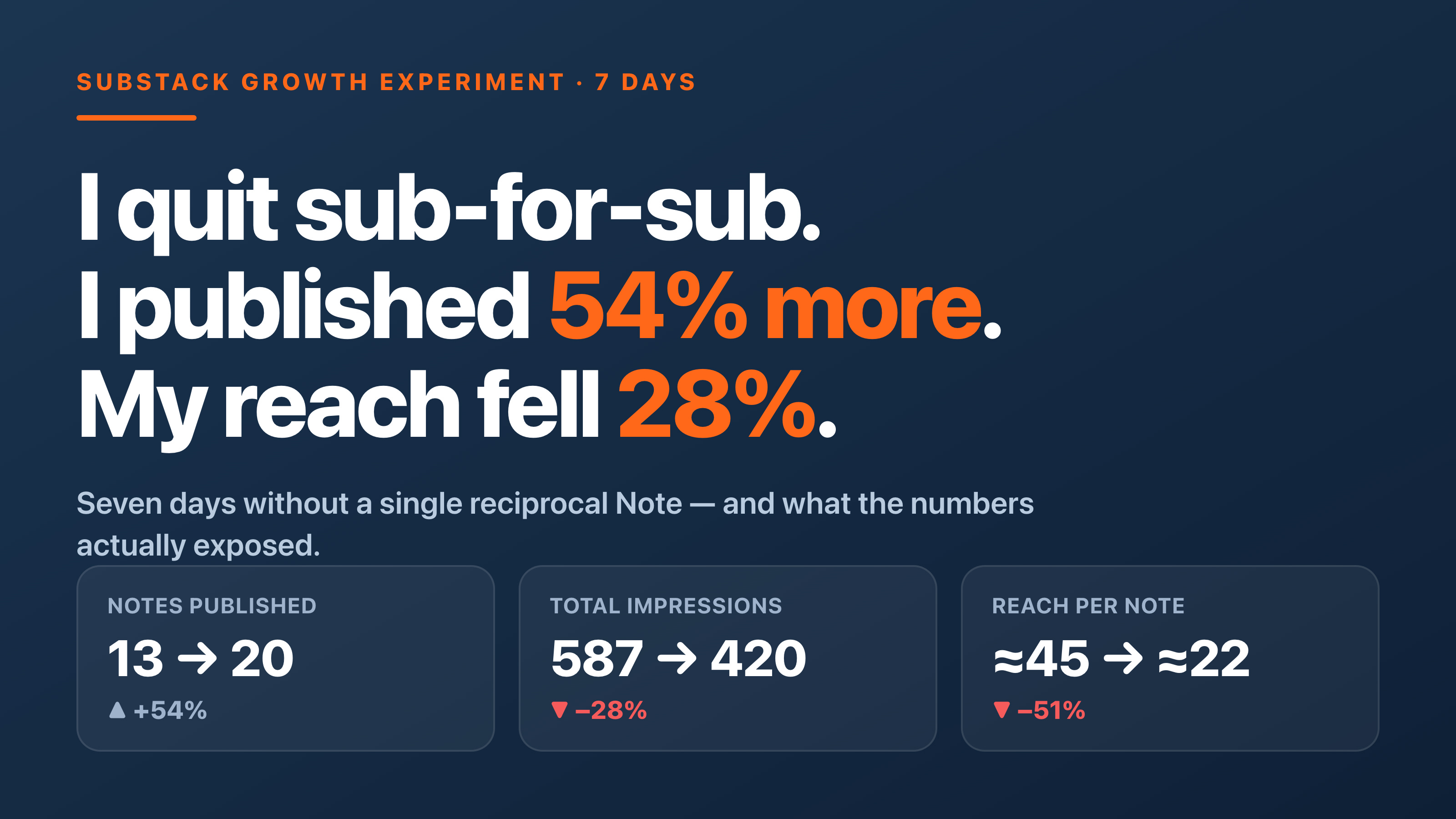
I published 54% more Notes, but my total reach fell by 28%.
And the average measurable reach of each Note was cut roughly in half.
That result was uncomfortable.
It was also exactly what I needed to see.
Why I stopped a strategy that was clearly working
When I started this Substack, I wanted to understand how a completely new publication could grow from zero.
Subscribe-for-subscribe worked.
At least, it worked according to the most visible metric: subscriber count.
Two reciprocal-support Notes alone brought me:
867 combined impressions
55 combined replies
63 subscribers directly attributed by Substack
One Note generated 50 attributed subscribers.
The other generated 13.
For a new account, those numbers were difficult to ignore.
My subscriber count grew quickly. I eventually reached 253 subscribers after publishing 130 Notes and 12 articles.
But another problem appeared.
I could see how many people had subscribed.
I could not tell how many had subscribed because they genuinely wanted to read my work.
Would they open my next article?
Would they return?
Would they interact when there was no subscription expected in exchange?
Was I building an audience, or simply increasing a number?
The only way to find out was to remove the tactic responsible for the fastest growth.
The rules of the experiment
For the following period, I stopped all explicit reciprocal-growth activity.
What I stopped
I did not publish any subscribe-for-subscribe Notes.
I did not promise to follow people back.
I did not subscribe to publications simply because their writers had subscribed to mine.
I did not ask people to comment “done” so that I could return the action.
What I continued
I kept publishing original Notes.
I replied to other creators when I had something relevant to add.
I published articles.
I participated in conversations.
I promoted my work selectively.
I continued improving my profile, content and tools.
The goal was not to stop growing.
The goal was to see what remained when the transactional activity disappeared.
What happened
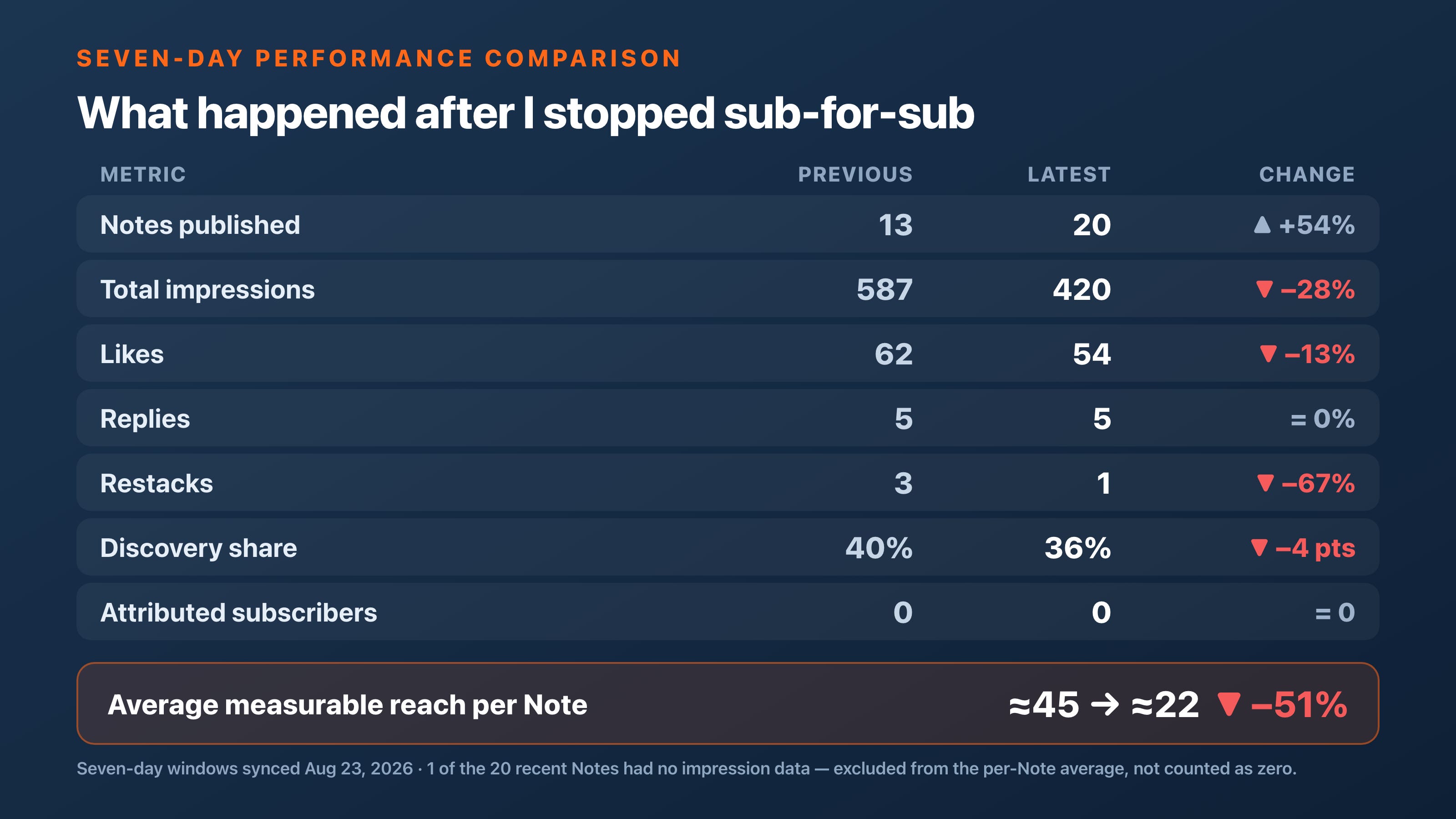
The following comparison comes from my latest seven-day analytics window, synced through August 23, 2026.
Notes published — 13 → 20 (+54%)
Total impressions — 587 → 420 (–28%)
Likes — 62 → 54 (–13%)
Replies — 5 → 5 (no change)
Restacks — 3 → 1 (–67%)
Discovery share — 40% → 36% (–4 points)
Attributed subscribers — 0 → 0 (no change)
One of the 20 recent Notes did not have impression data available, so it should not be treated as receiving zero impressions.
Across the 19 Notes with measurable data, the average was approximately 22 impressions per Note.
During the previous period, the average was approximately 45 impressions per Note.
That means the measurable reach per Note fell by roughly half.
I created more content.
I generated less total distribution.
And each individual Note received significantly less attention.
Publishing more did not solve the problem
The obvious assumption was that more Notes would create more opportunities for discovery.
That did not happen.
I published seven additional Notes, but received 167 fewer impressions.
This does not necessarily mean that publishing more directly caused the decline.
This was not a controlled scientific experiment. Timing, topics, audience activity and Substack distribution could all have influenced the results.
But it does show something important:
Publishing more content does not guarantee more distribution.
My problem was not a lack of output.
I had already published 130 Notes.
The problem was that most of those Notes did not have a strong distribution mechanism behind them.
The reciprocal Notes had one.
They gave readers a direct reason to respond:
Take this action, and I will return it.
Original Notes have to compete differently.
They need to be interesting enough to stop someone in the feed.
Useful enough to make them remember you.
Strong enough to earn a restack.
Relevant enough to attract the right reader.
That is much harder than offering an immediate transaction.
Zero attributed subscribers does not necessarily mean zero impact
Substack attributed no new subscribers directly to Notes in either seven-day period.
That does not prove that none of the Notes influenced a subscription.
Someone can:
See a Note.
Visit the profile later.
Read an article.
Return through another source.
Subscribe without the original Note receiving credit.
Attribution is incomplete.
That is why I do not want to claim: “My original content generated zero subscribers.”
The more accurate conclusion is:
Substack directly attributed zero subscribers to these Notes during the measured period.
That distinction matters.
It is easy to turn incomplete attribution into a confident but false growth lesson.
I have already made that mistake before.
The real benefit of stopping subscribe-for-subscribe
Stopping reciprocal growth did not immediately improve my numbers.
It improved the quality of the information behind them.
When transactional Notes dominated my dashboard, the obvious recommendation was: publish more reciprocal Notes, because they generate the most subscribers.
That recommendation was technically correct.
It was also strategically dangerous.
If I repeated it indefinitely, I could continue growing the subscriber count while making it increasingly difficult to understand whether anyone actually wanted the content.
Removing the tactic exposed the baseline.
It showed me what my publication could generate without an explicit exchange attached.
The baseline was weaker than I wanted.
But weak, honest data is more useful than impressive data I cannot interpret.
The experiment exposed my actual growth problem
I initially thought the question was: can original content replace subscribe-for-subscribe?
That was not the most useful question.
The real question was: can I build a repeatable distribution system for original content?
Right now, the answer is not yet.
Creating more Notes is not the system.
Publishing another article is not the system.
Posting a link repeatedly is not the system.
A real distribution system needs to answer:
Which topics attract the right people?
Which Notes generate profile visits?
Which readers return more than once?
Which creators amplify the content?
Which interactions lead to subscriptions?
Which subscribers become active readers?
Which growth is organic, community-driven or reciprocal?
Substack gives me the totals.
I need to understand the mechanism behind them.
Why I started building Subshack
This experiment is also the reason I started building Subshack.
I did not need another dashboard telling me that one Note had more impressions than another.
I needed to know why.
Was the Note successful because the idea was strong?
Because another creator amplified it?
Because it triggered reciprocal activity?
Because the same people repeatedly interacted with my content?
Or because it genuinely reached new readers?
Subshack now helps me separate those signals and identify:
Organic and reciprocal activity
Repeat engagers
Potential relationships
People amplifying my work
Subscribers becoming inactive
Content generating reach without conversion
Content generating conversion without obvious engagement
The goal is not to automate relationships.
The goal is to stop treating every impression, like and subscriber as if they meant the same thing.
They do not.
What I am changing now
I am not returning to mass subscribe-for-subscribe.
I will still subscribe to publications I genuinely want to read.
I will still support creators whose work interests me.
But that is a relationship, not a transaction.
For the next phase, I am changing five things.
1. Fewer repetitive Notes
Publishing more did not increase total reach.
I will focus on fewer Notes with stronger hooks, clearer opinions and more useful evidence.
2. More distribution around each idea
Instead of publishing an idea once and immediately replacing it, I will reuse strong ideas through different formats:
A data point
A contrarian observation
A practical lesson
A question
A personal example
3. More targeted interaction
I will stop interacting randomly.
I want to focus on people who are relevant to my topic, repeatedly engage with similar work and are likely to become genuine readers.
4. Separate acquisition from audience quality
Subscriber growth will remain useful.
But I will also measure:
Returning engagement
Article opens
Repeat interactions
Restacks
Replies
Activity after subscribing
5. Judge content by its job
Not every piece of content needs to generate subscribers.
Some content creates discovery.
Some builds trust.
Some starts conversations.
Some converts.
The mistake is judging all of them with a single number.
The next experiment
My next test will be more targeted.
For seven days, I will use Subshack to identify the people most relevant to my publication.
Not simply the people most likely to follow back.
I will focus on:
Repeat engagers
Relevant creators
People already interacting with Substack-growth content
Readers who have shown interest but have not subscribed
Existing subscribers who appear likely to become active readers
I will engage manually and compare the results with my previous random interaction.
Then I will measure:
Profile visits
Replies
New relationships
Attributed subscriptions
Returning readers
Time spent per result
That should answer a more valuable question: can targeted relationships outperform transactional growth?
The conclusion
Subscribe-for-subscribe gave me something every new creator wants: momentum.
It helped me leave zero.
It introduced me to other writers.
And two Notes generated 63 directly attributed subscribers.
Pretending it did not work would be dishonest.
But the experiment also revealed its limit.
Once I removed the transaction, publishing more content did not preserve the same distribution.
I published 54% more Notes.
My impressions fell by 28%.
My measurable reach per Note was roughly cut in half.
That does not mean I should return to the old strategy.
It means I now know what needs to be built next.
Not a faster way to increase the subscriber count.
A better system for reaching the right people, turning attention into genuine interest and identifying who actually comes back.
That is a much harder problem.
It is also a much more valuable one.
Want to see which parts of your own Substack growth are actually working?
Try Subshack — the Chrome extension for understanding your Notes, audience and growth.
Get the next experiment in your inbox — the blog is also a Substack newsletter you can subscribe to.
Subscribe free