Aug 26, 2026
19 Subscribers Came Through Notes. Not One Was Attributed to a Note.
Both numbers were correct. They measured two different layers of attribution.
The Truth About My Substack Growth — Part 4 of 5
Data snapshot: 23 August 2026, 16:43 UTC — 130 Notes, 253 current subscribers.
The cleanest comparison in my Substack experiment happened by accident.
On 12 August, I stopped using explicit subscribe-for-subscribe Notes. By my latest synced snapshot I had published exactly 65 Notes before that cutoff and 65 after it — two groups almost perfectly matched in size.
The result looked brutal.
My first 65 Notes were credited with 69 subscribers. Among the next 65, Substack returned usable attribution statistics for 64 — and those 64 were credited with zero.
If I had stopped at the Note-level dashboard, the conclusion would have been obvious:
I removed the tactic that worked, and my Notes stopped generating subscribers.
Then I opened the subscriber-level data. 29 current subscribers had joined after the cutoff, and 19 of them were marked as having come through Substack Notes.
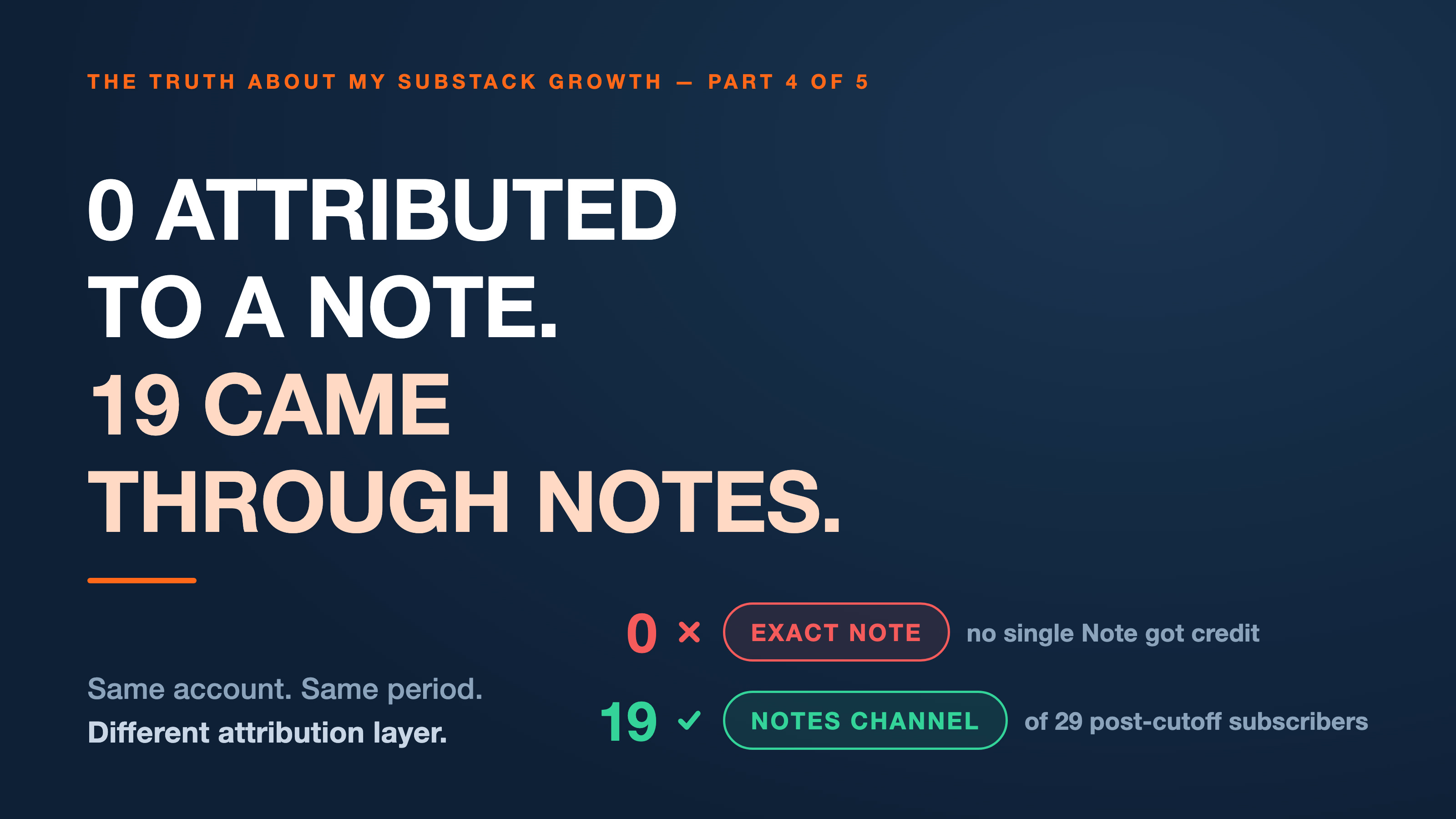
Zero attributed to an exact Note. Nineteen acquired through the Notes channel. Both numbers are correct — I had been asking two different questions as if they were the same one.
The 65-versus-65 comparison
Here is the complete split from the synced data:
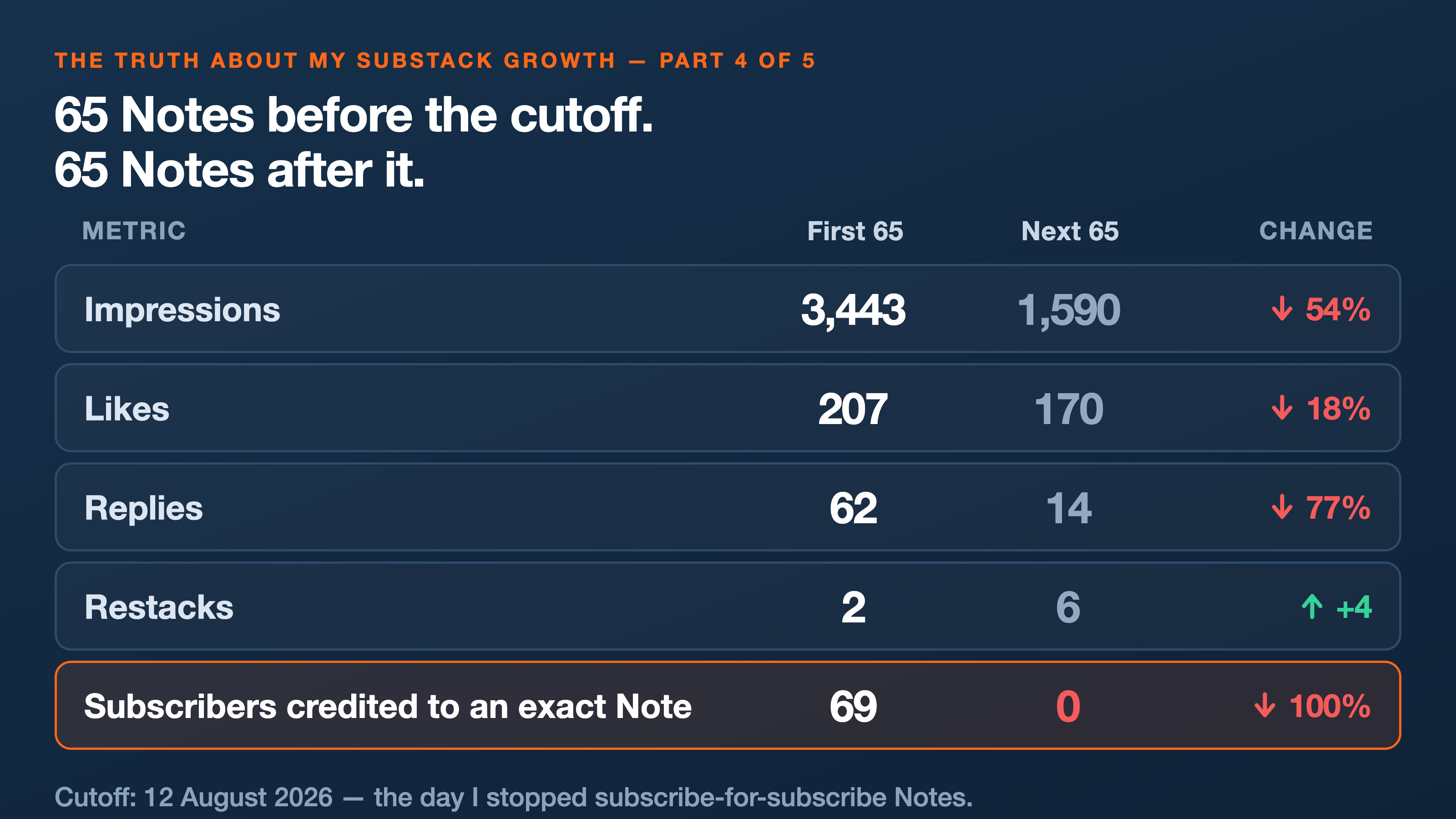
The shift was not limited to subscriber attribution. Impressions fell by roughly 54%, replies from 62 to 14, likes more moderately from 207 to 170. Restacks moved the other way, from 2 to 6, though the numbers are too small to treat as a stable pattern.
The reciprocal Notes in the first group gave people an immediate reason to act. Remove that incentive and the visible activity becomes much less dramatic.
But “less dramatic” is not the same as “zero growth”. That distinction was hidden one level deeper.
Exact-content attribution is not channel attribution
The Note-level metric answers a narrow question:
Which exact Note received credit for this subscription?
The subscriber record answers a broader one:
Through which Substack surface did this subscriber arrive?
After the cutoff, the 29 subscribers still on the list at the time of the sync broke down like this:
19 — Substack Notes
4 — reader profile discovery
3 — Substack app
1 — direct-to-app
2 — unknown
So roughly 66% of that cohort was associated with the Notes channel.
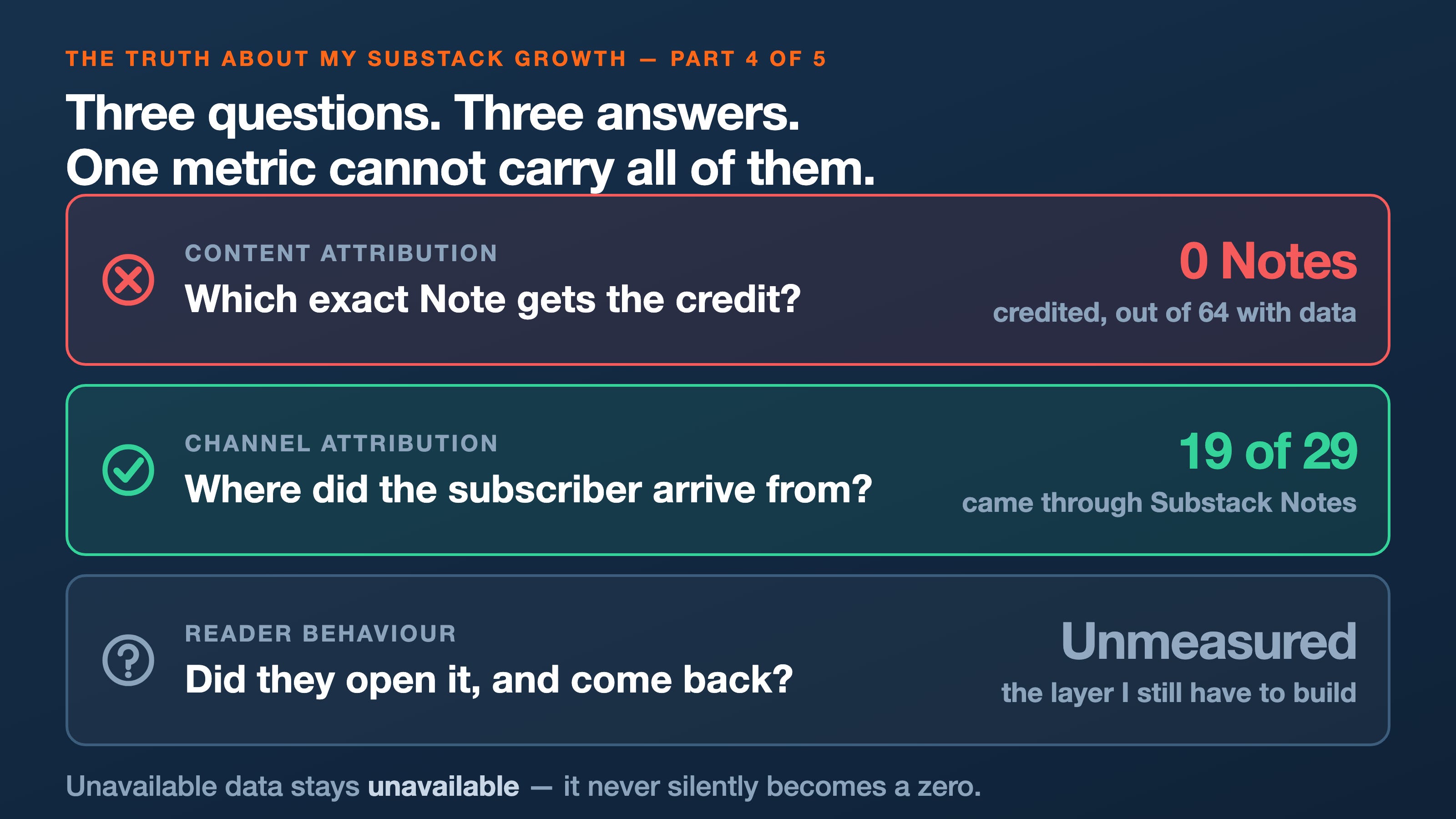
That does not identify the Note that persuaded each person, or prove that one of my own Notes was the decisive touchpoint. Someone could have found me through a reply, visited my profile after several interactions, or subscribed after seeing me repeatedly across the Notes ecosystem. The available data cannot isolate those paths.
The Note-level zero was not fake either: for the 64 post-cutoff Notes with returned attribution data, no individual Note received subscriber credit. The mistake would be translating that into:
Notes produced no subscribers.
That goes beyond what the metric can support. It is the same problem my classifier exposed in Part 3: the raw number is correct while the lesson extracted from it is wrong. There the missing context was intent; here it is grain — one table measures an exact piece of content, the other measures the wider acquisition surface.
The fix is not to pick whichever number makes the better story. It is to keep both, and label them correctly.
What the comparison actually supports
1. Removing the reciprocal incentive reduced visible activity. The second group received fewer impressions and far fewer replies — consistent with reciprocal Notes being unusually effective at creating immediate action. It is not a controlled causal experiment: topics, timing, audience size and content mix also changed.
2. Exact Note attribution disappeared. No post-cutoff Note with returned attribution data received direct subscriber credit. That is a real weakness in the second group.
3. The Notes channel still participated in acquisition. Nineteen current subscribers who joined after the cutoff were associated with Substack Notes at the channel level. The data cannot identify the decisive interaction.
4. Acquisition is still not the final outcome. What matters is what those people did after joining — whether they received the next article, opened it, came back, replied or restacked without being offered anything in exchange. Part 2 showed how wide that gap can get: my subscriber count grew while my open rate fell. That is the measurement layer I still need to improve.
The experiment I am redesigning
My first growth experiment optimised for speed — I described that version in Part 1. The next one needs to preserve the full path:
Distribution — how many people saw the Note, and how many were not already connected to me?
Channel acquisition — did the subscriber arrive through Notes, the app, profile discovery, search or another surface?
Exact-content attribution — when Substack can connect a subscription to a specific Note or article, which content receives credit? When it cannot, the answer should remain unknown, not silently become zero.
Reader behaviour — after joining, did they receive an email, open an article, return and interact again?
Editorial signal — which useful ideas generated replies, restacks and repeat attention without depending on a reciprocal promise?
I still want to publish useful Notes, write substantive replies and produce deeper articles. I also want to test one external community at a time instead of dropping links everywhere and calling that distribution.
But subscriber speed is no longer the score that decides whether the experiment worked. The system needs to distinguish:
Who arrived, where they arrived from, what received credit — and whether they came back.
What I am changing in Subshack
I am adding this distinction to Subshack. A zero in the content table should not silently become a zero in the growth story.
The product should show exact attribution when it exists, channel-level attribution when that is all the data supports, unavailable data as unavailable, and post-subscription behaviour separately.
No invented precision. No automatic causal story. Just the strongest conclusion the available data can actually support.
If you want to see the same distinction on your own account before I ship it, run the free Substack profile audit — it reads your public profile and scores it without asking for a login.
The uncomfortable conclusion
My first 65 Notes told a simple story: attention, replies and attributed subscribers, quickly. My next 65 looked much worse in the Note-level dashboard.
But the subscriber records showed that growth had not stopped. It had become harder to attribute.
That is less satisfying than a clean before-and-after victory. It is also more useful. Because the real question is no longer whether Notes generated zero subscribers or nineteen. It is:
Which exact content can be credited, which channel participated, and did those subscribers become readers?
Until a dashboard separates those questions, the cleanest number may produce the weakest lesson.
Have you ever seen two Substack screens appear to tell different growth stories? Which number did you trust?
Tell me in the comments — especially if you have hit a similar attribution gap.
Next in Part 5: I compare what happened when I published on X and Bluesky, contributed on Reddit, and waited for Google — because publishing everywhere is not the same as building distribution.
Method. Subshack snapshot of 23 August 2026, 16:43 UTC. The post-cutoff cohort counts people who joined on or after 12 August and were still subscribed at the sync. One of the 65 post-cutoff Notes returned no impression or attribution data. Channel source does not identify the exact content that caused a subscription. Observational, not a controlled experiment.
Get the next experiment in your inbox — the blog is also a Substack newsletter you can subscribe to.
Subscribe free