Aug 7, 2026
I Hit 100 Substack Subscribers in My First Week. Then I Added 50 More Before the Week Was Even Over.
I started from zero. Reaching 100 felt like the milestone. What happened immediately after was even more interesting
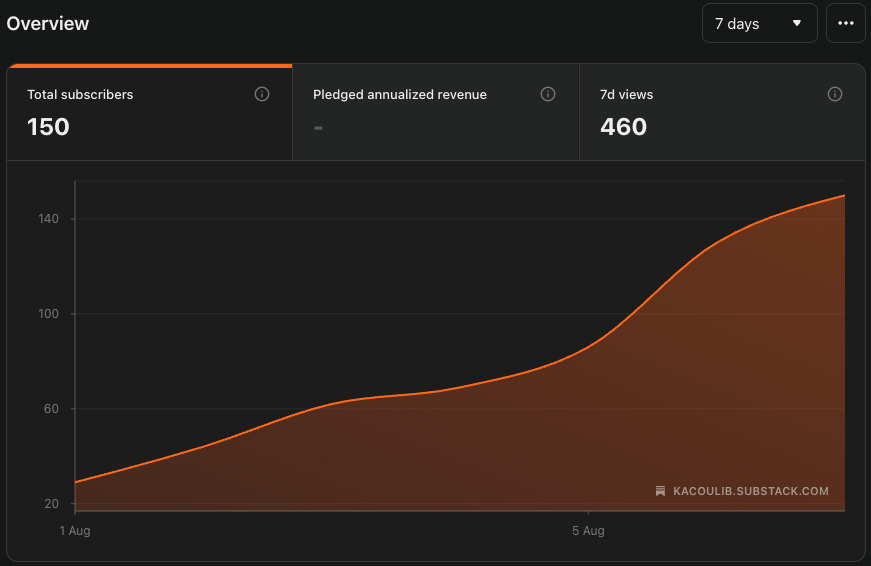
A few days ago, I had no Substack audience.
Then I reached 100 newsletter subscribers during my first week.
Before that first week was even over:
100 → 150 subscribers.
The obvious reaction would be to celebrate the number.
But I’m more interested in understanding why the growth continued after 100 — and whether those subscribers become real readers.
I’m documenting these experiments as they happen: the numbers, what I tried, what appeared to work, and what I still cannot prove.
The baseline
I started this publication from zero.
During my first few days, I tested several ways of getting discovered:
participating in creator and subscribe-for-subscribe Notes
replying to other writers
publishing my own Notes
sharing growth experiments publicly
writing articles about what I was learning
linking those articles when they genuinely matched a conversation
That helped me reach my first 100 subscribers.
But the interesting part is that the growth didn’t stop at 100.
Before my first week was finished:
Subscribers: 150
That means another 50 subscribers arrived after the 100-subscriber milestone.
What changed after 100?
I didn’t suddenly discover a new growth hack.
I kept doing largely the same things.
But one thing had changed:
I now had more content for people to discover when they landed on my profile.
Early on, someone visiting my profile saw almost nothing.
Now they could see:
growth experiments
original Notes
opinions about Substack growth
actual results
mistakes and lessons
articles explaining what I was learning
The profile itself had become more useful.
If you want to see what your own profile shows a first-time visitor, I built a free Substack profile audit that scores it out of 100.
Instead of asking:
Who is this person?
a visitor could start asking:
Do I want to keep reading this?
Notes created the surface area
One thing is becoming increasingly clear to me:
Notes have been one of my most important discovery surfaces.
Every Note creates another opportunity for someone to:
see my name
read an idea
reply
visit my profile
discover an article
subscribe
That doesn’t mean posting for the sake of posting.
The Note still needs to give someone a reason to stop.
But original Notes continuously create new entry points into the rest of my content.
Reciprocal support helped — but it is not enough
I also participated in reciprocal-support Notes.
Things like:
Subscribe = Subscribe
Follow = Follow
They helped create initial visibility.
For a publication starting from zero, that can be useful.
But someone subscribing because you subscribed to them is not necessarily subscribing because they want your next article.
That’s why I started publishing original Notes alongside those interactions.
Reciprocity can create the introduction.
Your content has to give people a reason to stay.
Different content may have different jobs
Another pattern is starting to appear in my article statistics.
My more opinionated article about subscribe-for-subscribe attracted more attention and discussion than my straightforward growth reports.
But one of my practical articles was better at directly generating a subscriber.
That suggests different content may serve different purposes:
Opinionated content → attention
Practical content → potential conversion
Notes → discovery
Replies → conversations
Growth reports → credibility
I don’t have enough data yet to call this a rule.
But it changes how I think about publishing.
150 subscribers does not mean 150 readers
This is the part I care about next.
150 subscribers sounds good.
But it doesn’t tell me:
how many will open the next article
how many will return
how many will reply
how many will unsubscribe
how many joined mainly because of reciprocity
how many genuinely care about the topic
Subscriber count measures acquisition.
It does not automatically measure audience quality.
What I still cannot prove
I cannot accurately attribute all 150 subscribers to specific actions.
Several things were happening simultaneously:
Notes
replies
reciprocal-support threads
articles
profile visits
Substack discovery
So this is not:
“Do these exact things and you’ll get 150 subscribers.”
It’s an experiment happening in public.
The growth is real.
The attribution is still incomplete.
What I’m testing next
Getting subscribers is no longer the main question.
Now I want to understand what happens after the subscription.
I’ll be tracking:
article views
open rates
replies
comments
profile visits
new subscribers
returning readers
retention
I’ll also continue testing different types of Notes:
practical tactics
opinions
questions
experiments
progress updates
warnings about common growth practices
The question becomes:
Which actions attract people who actually keep reading?
Conclusion
Getting from zero to 100 subscribers was the first milestone.
Going from 100 to 150 before the first week was even over was more interesting.
It suggests that early distribution becomes more valuable as your profile builds up more content worth discovering.
Notes create discovery.
Articles provide depth.
Conversations create familiarity.
Now the real experiment begins:
Can those 150 subscribers become an actual audience?
I’m documenting the numbers, mistakes and results as I go.
Subscribe to follow the next experiment — when I stop measuring how many people subscribe and start measuring how many actually stay.
Get the next experiment in your inbox — the blog is also a Substack newsletter you can subscribe to.
Subscribe free