Aug 19, 2026
I Checked the Data Behind My Own Growth Advice. It Was Worse Than I Thought
I analysed 105 Notes. Two of them accounted for 56 of the 62 subscribers Substack attributed to individual Notes — 90%.
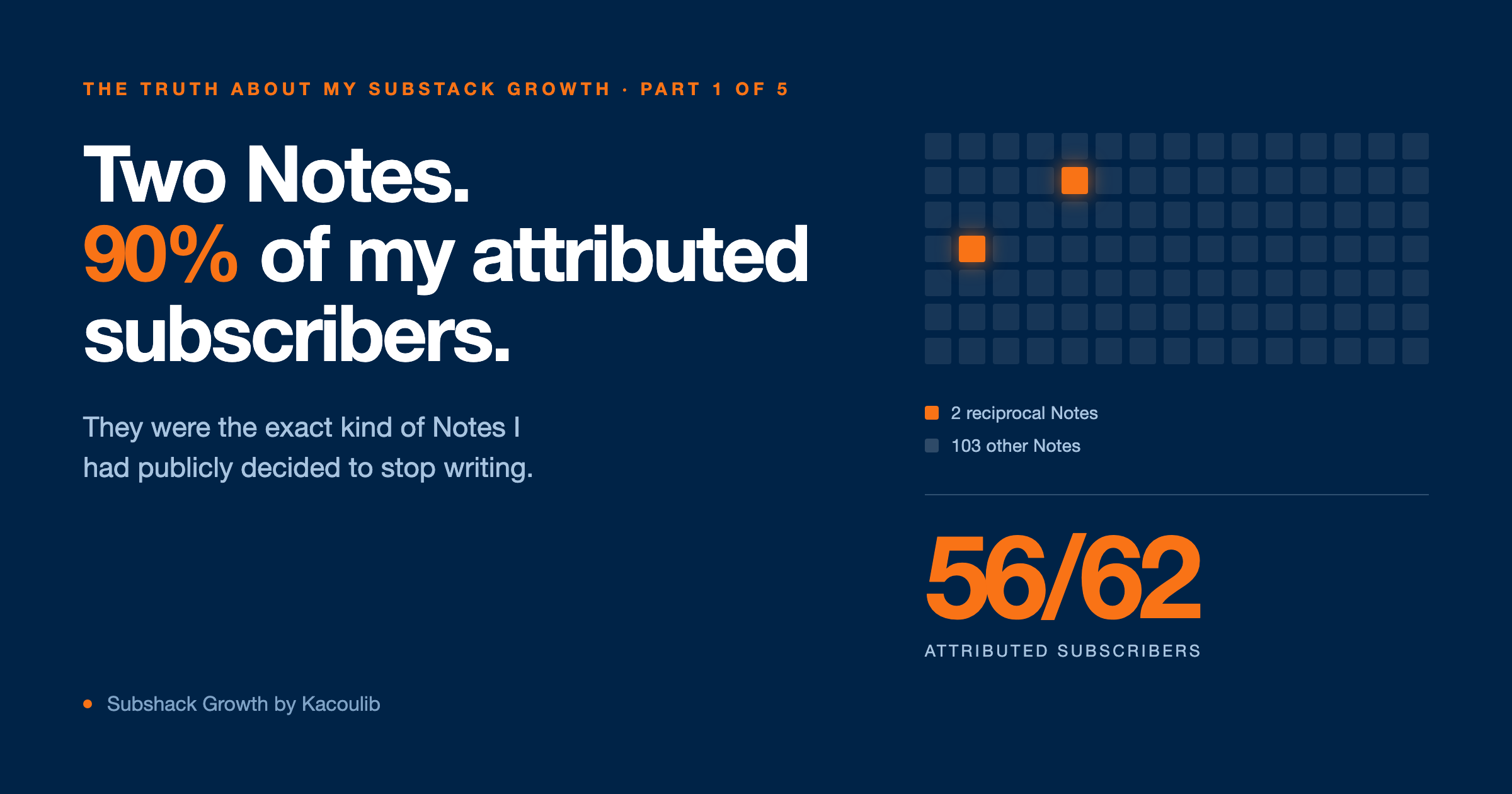
The Truth About My Substack Growth — Part 1 of 5
Two weeks ago, I thought I had found a fast way to grow a new Substack.
I started from zero, used Notes heavily, joined conversations, and hit my first 100 subscribers in one week, before crossing 150 shortly afterward
The number looked good.
The method looked repeatable.
So I began sharing what I was learning.
Then I built a tool to analyse my own growth.
The first thing it showed me was that the story I had been telling was incomplete.
I analysed 105 of my Notes.
This audit covers 105 Notes published between July 28 and August 17, 2026.
Only two of them were responsible for 90% of the subscribers I could attribute to individual Notes.
And those two Notes were the exact kind of content I had publicly decided to stop writing.
The number I couldn’t ignore
The first Note was direct:
Follow = Follow
Subscribe = Subscribe
Let’s start.
It generated:
479 impressions
39 replies
44 attributed subscribers
The second was less explicit:
To everyone publishing on Substack — I’m reading. I’m subscribing. I’m supporting you. Let’s connect.
It generated:
355 impressions
14 replies
12 attributed subscribers
Together, these two Notes represented only 1.9% of the 105 Notes in my dataset.
But among the six Notes for which subscriber attribution was recorded, they accounted for 56 of the 62 attributed subscribers.
That is 90%.
The other four Notes carrying attribution data accounted for the remaining six subscribers.
For the other 99 Notes, attribution was unavailable—not zero.
The obvious recommendation from the data would be simple:
Write more networking Notes.
But that recommendation would optimise the number while ignoring the reason behind it.
The tactic didn’t fail. It worked too well.
Subscribe-for-subscribe is often criticised because it creates low-quality subscribers.
That description is too comfortable.
My data suggests a more dangerous problem:
Reciprocal growth can outperform editorial content so dramatically that it becomes difficult to see what your audience genuinely values.
Here is what my data showed:
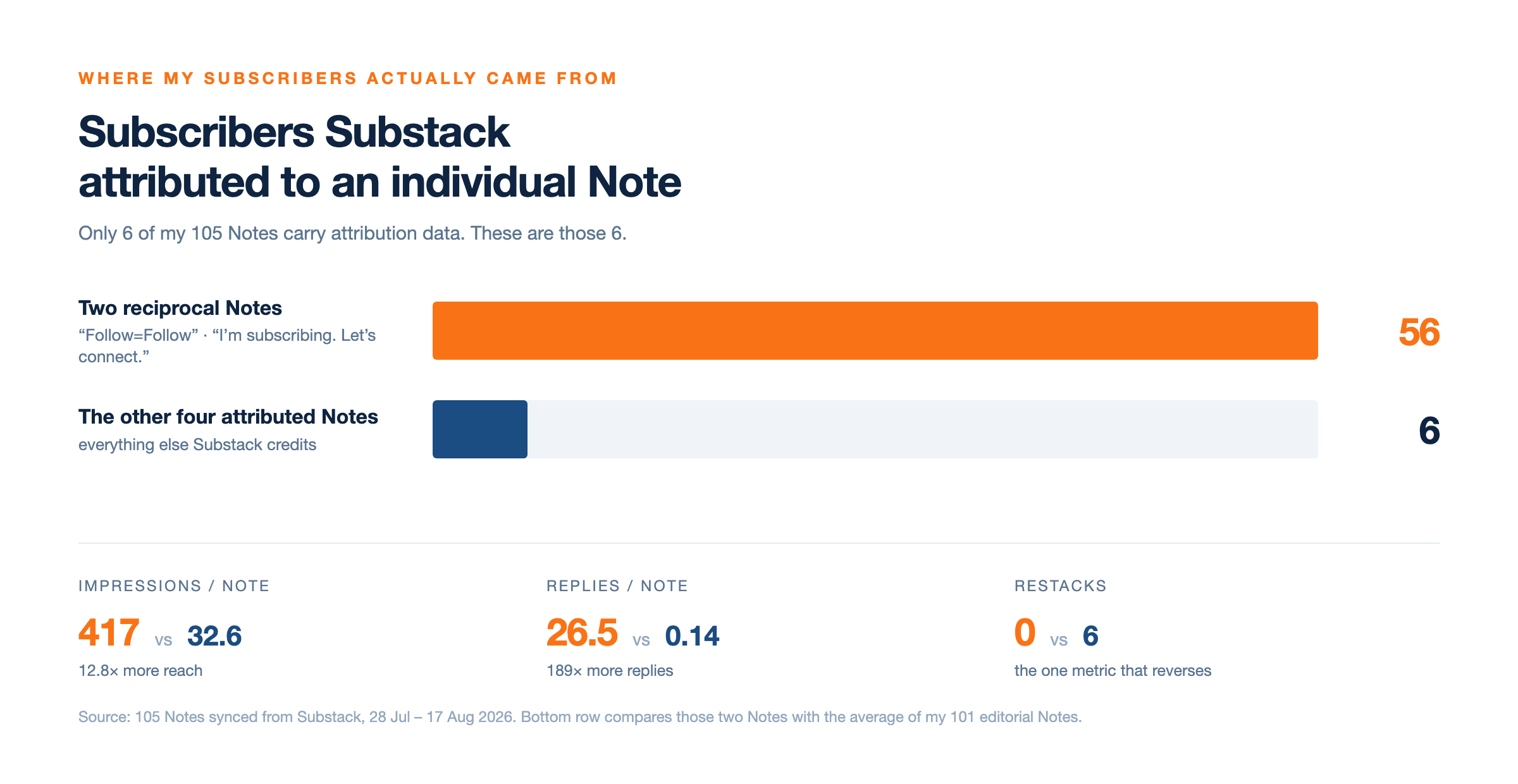
12.8 times more impressions and 189 times more replies per Note, every normal analytics dashboard will tell you to repeat it.
The metric is not fake.
The activity happened.
The subscribers are real people.
But the recommendation can still be wrong.
Those people may have subscribed because they wanted support in return—not because they wanted to read my next article about Substack growth.
That distinction does not appear in the subscriber count.
The signal that was missing
The two strongest acquisition Notes generated zero restacks.
That matters.
A like is cheap.
A reply can be part of an exchange.
A subscription can be reciprocal.
A restack is different.
When someone restacks a Note, they put it in front of their own audience.
They attach a small part of their credibility to it.
The two Notes that generated most of my attributed subscribers were successful at activating people.
But nobody chose to redistribute them.
They created transactions, not amplification.
That does not make the Notes worthless.
One of them helped me meet other new writers, and some of those relationships may become genuine.
But it changes what I can honestly claim they proved.
They proved that reciprocal and community-driven Notes can grow a subscriber count quickly.
They did not prove that the underlying content created demand.
The limitation I need to state clearly
My attribution data is incomplete.
Subscriber attribution was recorded for only six of the 105 Notes in this audit.
That means I cannot honestly claim that these two Notes generated 90% of every subscriber I acquired.
The accurate claim is narrower:
Among the six Notes for which subscriber attribution was recorded, the two strongest accounted for 56 of the 62 attributed subscribers—90%.
Small datasets make dramatic headlines easy.
They also make methodological honesty essential.
At the time of this audit, I had:
241 subscribers
105 analysed Notes
9 published articles
a publication that is only a few weeks old
This is not a universal study of Substack.
It is an audit of my own behaviour.
What this audit changed
I no longer want my analytics to answer only this question:
Which Notes produced the biggest numbers?
I need them to answer a harder one:
Which Notes produced behaviour that is consistent with genuine interest?
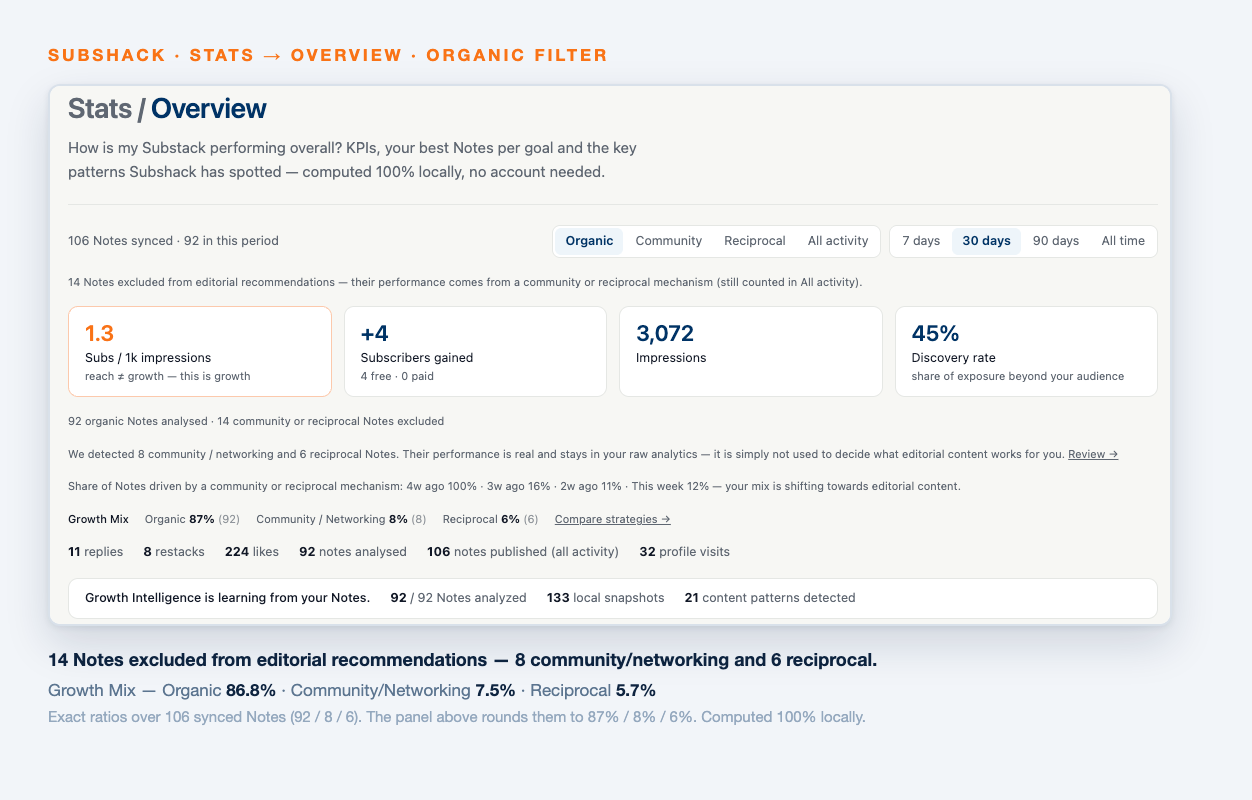
That means separating raw performance from the mechanism that produced it.
The raw numbers must remain untouched.
Hiding reciprocal subscribers would be dishonest.
But recommendations should not automatically treat these three things as the same signal:
a reciprocal interaction
a community conversation
an editorial response
They may produce similar numbers for completely different reasons.
That is what I am now building into Subshack.
The uncomfortable conclusion
My early growth was not imaginary.
The subscribers were real. So were the replies.
But I still do not know how much of that growth represented genuine demand for my work.
And if I want to give other writers growth advice, that is the first question I need to answer.
I built a tool to analyse my Substack growth.
One part of it is already free and public: a Substack profile audit that scores what a first-time visitor sees on your profile, out of 100.
The first thing it told me was that my growth story did not survive contact with the data.
I’m publishing the numbers anyway.
If you removed your two best-performing Notes, would your growth story still hold?
Mine didn’t.
Have you ever used reciprocal growth? Did those subscribers continue reading afterward?
Tell me what happened in the comments.
Next in Part 2: My subscriber count kept growing while my article open rate fell from 34% to 18%. I’ll show what happened to engagement while the list got bigger.
Get the next experiment in your inbox — the blog is also a Substack newsletter you can subscribe to.
Subscribe free